


Lightweight Concrete Additives | High-Performance Foaming Agents for Cellular Concrete

Stop guessing. Use an air entraining admixture for freeze-thaw resistance in any exterior concrete in a cold climate.
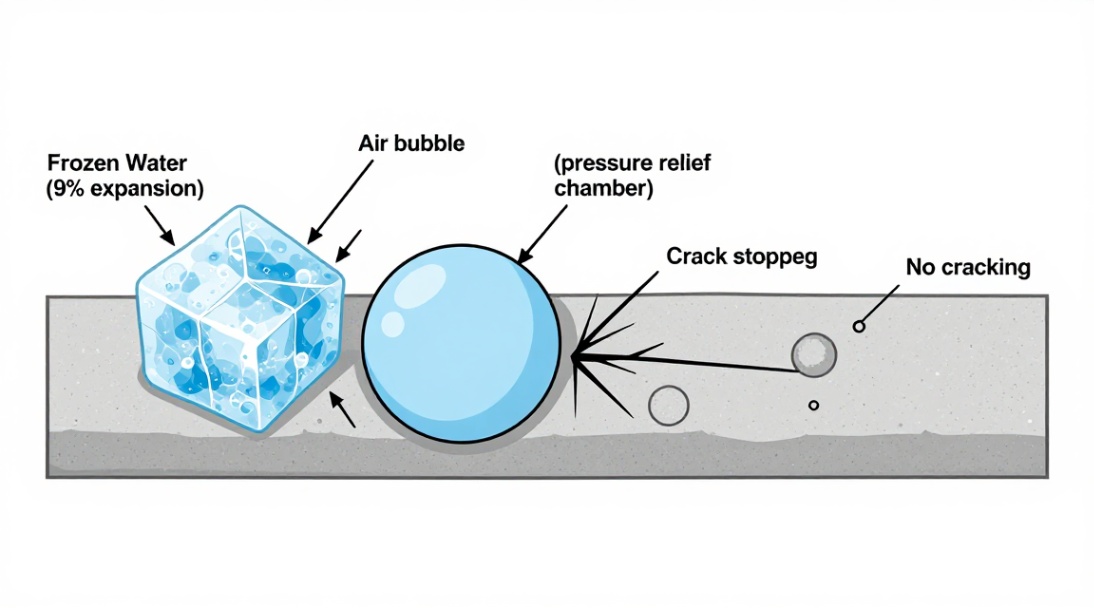
That is the short answer. Water expands by 9% when it freezes. If concrete traps that expanding water, internal cracks form. The concrete scales, spalls, and fails. An air entraining admixture for freeze-thaw resistance creates billions of tiny, stable air bubbles. These bubbles act as pressure relief chambers. Expanding water pushes into them instead of cracking the paste. The concrete survives winter after winter.
But this solution is not free. You trade some strength and add complexity to quality control. Let me walk you through the exact trade-offs so you make the right choice for your pour.
1. The mechanism: Tiny bubbles, huge impact
An air entraining admixture introduces microscopic bubbles (typically 10 to 1,000 microns in diameter) into the fresh concrete mix. These bubbles are not the accidental voids from poor compaction. They are stable, uniformly distributed, and engineered to stay intact during mixing, transport, and placement.
When freeze-thaw cycles hit, the pressure from freezing water dissipates into these empty spaces. If the bubble spacing is close enough, the concrete suffers no damage. This is why we measure spacing factor and specific surface — not just total air content.
1.1. What happens without air entrainment?
Plain concrete with no air entrainment fails in as few as 10 to 30 freeze-thaw cycles in saturated conditions. Scaling starts at the surface. Cracks propagate inward. Repairs cost more than the original pour. Do not skip AEA for any exposed concrete in a freezing climate.
2. The full comparison: Benefits versus drawbacks
The table below gives you a clear, side-by-side look at what an air entraining admixture for freeze-thaw resistance does to fresh and hardened concrete.
| Aspect | Benefits | Drawbacks |
|---|---|---|
| Freeze-thaw durability | Extends service life by decades. Prevents D-cracking and surface scaling. | None. This is the primary reason to use AEA. |
| Compressive strength | Minimal effect if air content is correct. | Each 1% increase in air content reduces strength by roughly 5%. Over-entrainment weakens the mix significantly. |
| Workability | Bubbles act as tiny ball bearings. Pumping and placing become easier. Segregation decreases. | Mix looks foamy if over-dosed. Finishers may complain about tackiness. |
| Bleeding and segregation | Reduces bleed water. Less surface laitance. | Can make surface finishing slightly more challenging in hot weather. |
| Cost | Low cost per cubic yard. Best value durability improvement available. | Requires extra field testing. Technician skill matters. |
| Quality control | Simple field tests exist (ASTM C231 pressure meter). | Air content changes during transport, vibration, and pumping. Frequent adjustments needed. |
| Compatibility with other admixtures | Works with most water reducers and superplasticizers. | Some superplasticizers reduce air content. Must test combos in advance. Retarders and accelerators may alter bubble stability. |
3. When the drawbacks beat the benefits
There are situations where you should not use an air entraining admixture for freeze-thaw resistance — even if frost is a risk. The logic is simple: if the concrete will never be saturated, it cannot freeze internally. Dry concrete suffers no freeze-thaw damage. Interior slabs, roof toppings under waterproofing, and arid climate pavements rarely need AEA.
Another case: high-strength structural members where every psi counts. If your design requires 8,000+ psi concrete and you need freeze-thaw resistance, you compensate for the strength loss by lowering the water-cement ratio or using silica fume. Test the combo before the pour.
4. Field testing: Trust the pressure meter, not your eyes
You cannot judge air content by looking at the mix. A foamy surface means over-entrainment. A flat, wet look may mean too little air. Use the ASTM C231 pressure meter on fresh concrete. Calibrate it daily. Test every truck load for critical pours.
Target air contents typically range from 4% to 8% by volume of the concrete. The exact number depends on your aggregate size and exposure severity. Larger aggregates need less total air because the bubble spacing matters more than total volume.
Testing only at the plant is not enough. Transport, pumping, and vibration all knock out air bubbles. Measure air content again at the point of placement. Adjust your dosage on the fly if needed.
5. Dosage: Start low, test, adjust
There is no universal dosage for an air entraining admixture for freeze-thaw resistance. The amount depends on:
- Cement type and fineness
- Aggregate shape and gradation
- Mix temperature (hot mixes lose air faster)
- Presence of other admixtures
- Mixing energy and duration
A typical starting point is 0.2 to 0.5 fluid ounces per 100 pounds of cement. But do not trust the can label alone. Make a trial batch at your plant, measure the air content, and then adjust. Record every change.
6. Interactions with superplasticizers and accelerators
Here is where most field problems occur. Some high-range water reducers (superplasticizers) collapse the air void system. Others increase it. You must test the exact combination of admixtures you plan to use. Do not assume compatibility.
Calcium chloride accelerators (often used in cold weather) can destabilize air bubbles. If you need both acceleration and air entrainment, choose a non-chloride accelerator or use an AEA that is specifically formulated to work with salts.
Retarders and mid-range water reducers generally have less impact, but changes in slump and viscosity still affect the bubble system. Test, test, test.
7. Quality control for long-term success
The single biggest mistake is testing air content only at the beginning of the pour. Air content changes as the concrete sits in the truck, especially during hot weather. Re-test every 30 minutes, or every truck, whichever comes first.
Vibration removes air. Over-vibration can reduce air content by 1% to 2%. Standard practice: vibrate only long enough to consolidate — typically 5 to 15 seconds per insertion. Do not poker through the mix multiple times.
Pumping also reduces air content. If you pump concrete, increase your target air content at the plant by 1% to 1.5% to compensate for the losses during pumping.
8. The bottom line: AEA is mandatory for exposed cold-weather concrete
I have seen too many parking garages, bridge decks, and sidewalks fail because someone skipped the air entraining admixture for freeze-thaw resistance to save 0.5% on the admixture cost. That false economy costs 10x more in repairs a few years later.
Use AEA. Test every load. Train your crew. Adjust your dosage for weather, pumping, and vibration. Your concrete will last 50+ years instead of 10.
Now, here is your action step.
Buy a calibrated pressure meter if you do not already own one. Contact your admixture supplier and request a compatibility chart for your specific superplasticizer and AEA combination. Run a trial batch this week — not the morning of the pour. Do not trust memory. Write down every dosage and result.
Your project deserves concrete that survives winter after winter. Make the smart choice. Use an air entraining admixture for freeze-thaw resistance correctly, and your work will stand the test of time.
Supplier
ConcreteAndMore is a trusted global supplier of high-performance concrete admixtures and construction chemicals. With years of industry expertise, we specialize in providing innovative solutions including polycarboxylate superplasticizers, concrete fibers, defoamers, foaming agents, and advanced aerogel thermal insulation products. If you are interested in concrete admixture, please feel free to contact us!