


Lightweight Concrete Additives | High-Performance Foaming Agents for Cellular Concrete

Hydrophobic Aerogel for Cryogenic Insulation: Stop Making These Costly Mistakes
If you are insulating a cryogenic tank for LNG, liquid hydrogen, or aerospace propellant, the promise of hydrophobic aerogel is seductive. Ultra-low thermal conductivity. No moisture ingress. Thin insulation layers. It sounds like the perfect fix. But here is the hard truth we have learned over decades of field failures: most engineers misuse this material. They follow the datasheets, ignore the physics, and end up with a mess of cracked blankets, ice formation, and boil-off rates that ruin their project economics. This article is not a sales pitch. It is a warning. Let us walk through the five biggest traps so you can avoid them.
1. Ignoring the Real Mechanism: Hydrophobicity Is a Shield, Not a Cure-All
We must start with a fundamental reality check. Hydrophobic aerogel is a nanoporous silica structure. Its magic comes from a surface treatment – typically a silylation process – that makes it repel liquid water. This prevents moisture from condensing and freezing inside the insulation during cryogenic service. That is critical. Freeze-thaw damage from trapped water is the number one killer of conventional cryogenic insulations like polyurethane foam and perlite. The aerogel solves that. But here is the trap: engineers assume hydrophobicity protects against everything. It does not. The aerogel is still a brittle solid. It still dusts under vibration. It still loses its hydrophobic coating if exposed to high temperatures or aggressive chemical cleaning. Do not treat it like a magic bullet. Treat it like a precision tool that needs careful handling.
2. Misunderstanding Thermal Conductivity: The Number on the Brochure Is a Lie
Let us talk about the most dangerous number in our industry: 0.015 W/m·K. That is the typical thermal conductivity claim for hydrophobic aerogel under ideal conditions. It is a beautiful number. But it is measured in a lab under vacuum or dry nitrogen at room temperature. Your cryogenic application is at -196°C for liquid nitrogen or -253°C for liquid hydrogen. At those temperatures, the gas within the aerogel pores condenses. The thermal conductivity changes. It can double or triple depending on the pore size distribution and the gas species. Also, if you do not maintain a vacuum or purge gas around the aerogel, convective heat transfer kicks in. The real-world effective thermal conductivity of hydrophobic aerogel for cryogenic insulation applications is often 0.025 to 0.040 W/m·K. Do not design your system based on the 0.015 number. You will undersize your insulation and get massive boil-off. Trust the physics, not the brochure.
3. Overlooking the Brittleness and Dust Generation Problem
We have seen this happen countless times. A design team specs hydrophobic aerogel blanket for a large LNG storage tank. They install it. It works for a year. Then, thermal cycling or vibration from a nearby pump causes the aerogel to crack and crumble. The dust migrates into valves, instruments, and even the tank ullage space. This is not a hypothetical risk. Aerogel is amorphous silica. It is brittle. The nanoporous structure fractures easily under mechanical stress. The fix? You must integrate the aerogel with a fiber reinforcement – glass fiber, ceramic fiber, or even carbon fiber. Use an aerogel blanket or composite, not pure monoliths. And you must design a mechanical support system that limits strain on the insulation. Do not just glue it to the tank wall and hope for the best. That is a recipe for a particulate disaster.
4. Treating It Like Perlite or Vacuum Panels: A Critical Comparison Error
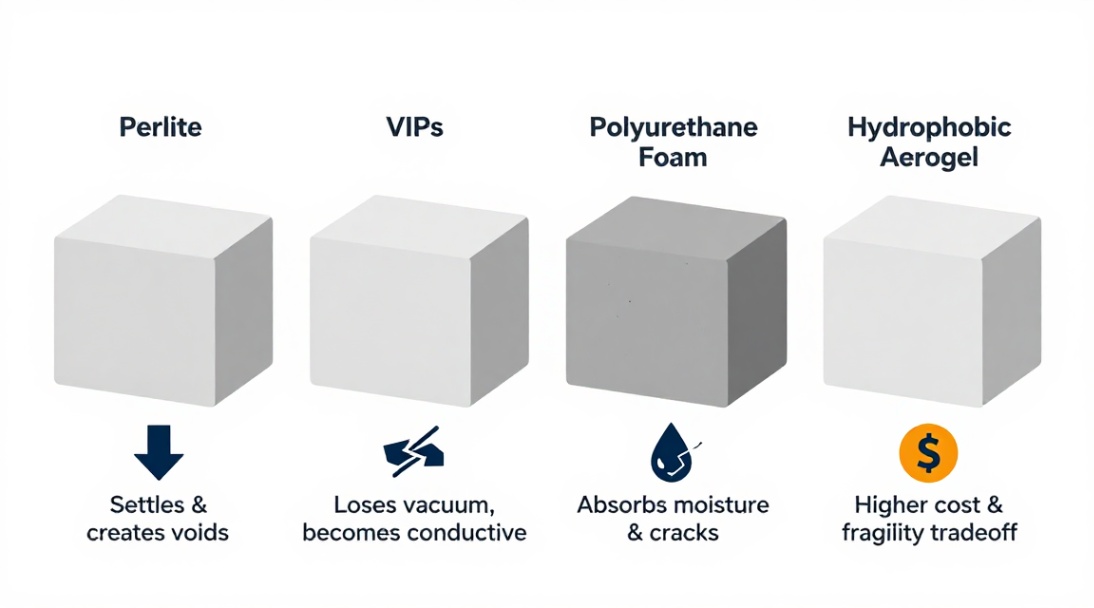
Let me be blunt: conventional cryogenic insulations like perlite, vacuum insulated panels (VIPs), and polyurethane foam each have a distinct failure mode. Perlite settles and compacts over time, creating voids. VIPs lose vacuum and become conductive. Foam absorbs moisture and cracks. Hydrophobic aerogel solves some of these problems but introduces new ones. For example, compared to perlite, aerogel is much more expensive per unit volume. Compared to VIPs, aerogel has a higher thermal conductivity when not under hard vacuum. Compared to polyurethane foam, aerogel is far more fragile and harder to apply in complex geometries. The mistake is choosing aerogel simply because it is trendy. Match the material to the specific constraints of your system. If you need a rigid, load-bearing insulation that can be walked on, aerogel is the wrong choice. If you need a flexible, thin insulation that repels moisture and fits around complex piping, aerogel might be perfect. Know the trade-offs.
5. Neglecting Handling Protocols and Cost of Failure
Here is a point that rarely makes it into the technical papers. Hydrophobic aerogel is expensive. A typical blanket can cost 5 to 10 times more than perlite or foam. That high cost creates a natural pressure to minimize the installed thickness. Do not fall for that. If you undersize the insulation to save money on material, you will pay far more in boil-off losses over the lifetime of the vessel. We have run the numbers. A 1% increase in boil-off rate on a large LNG tank can cost hundreds of thousands of dollars per year in lost product. The opposite mistake is also common: over-specifying aerogel thickness to compensate for uncertainty, which drives up capital costs unnecessarily. The solution? Do a proper thermal analysis that accounts for real-world conditions. Factor in a safety margin of 15-20% on thickness. And never install aerogel without a clean, dry, dust-controlled environment. Wet installation or contaminated surfaces ruin the hydrophobic coating immediately.
Final Warning: Reusable Systems and the Future
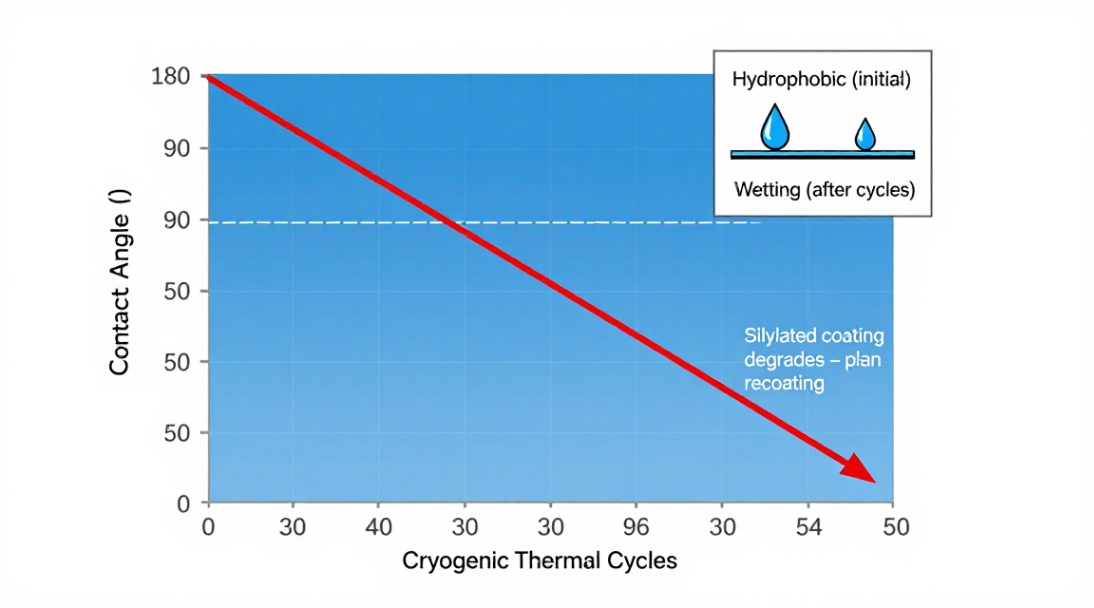
We see a growing trend in reusable launch vehicles and advanced cryogenic storage for space applications. Engineers are trying to use hydrophobic aerogel as a reusable insulation system. The logic makes sense: it is lightweight, it handles thermal cycling, and it repels moisture. But here is the catch we discovered through painful experience: the silylated hydrophobic coating degrades over repeated thermal cycles to cryogenic temperatures. After about 20 to 50 cycles, the contact angle drops, and water starts to adsorb. The insulation loses its edge. The fix is to plan for periodic recoating or replacement. Do not design a system that relies on the aerogel lasting for the entire life of the vehicle without maintenance. That is a failure waiting to happen.
Your Next Step: Test Before You Commit
We have shared these warnings because we have learned them the hard way. Hydrophobic aerogel for cryogenic insulation is a powerful material – when used correctly. When used incorrectly, it is an expensive headache. Our advice? Do not take our word alone. Build a small-scale test rig. Simulate your actual thermal cycling, vibration, and moisture conditions. Measure the effective thermal conductivity in your specific operating environment. Only then scale up. The cost of the test is a fraction of the cost of a full field failure.
Supplier
ConcreteAndMore is a trusted global supplier of high-performance concrete admixtures and construction chemicals. With years of industry expertise, we specialize in providing innovative solutions including polycarboxylate superplasticizers, concrete fibers, defoamers, foaming agents, and advanced aerogel thermal insulation products. If you are interested in concrete admixture, please feel free to contact us!