


Lightweight Concrete Additives | High-Performance Foaming Agents for Cellular Concrete

A Story of Two Slabs: What Went Wrong?
Two years ago, a contractor I mentor called me, voice tight with stress. He had just placed a large floor screed with foam concrete. “The density is all over the place,” he said. “One area is soft as sponge cake, another is cracking. The core samples are a disaster.” We traced the failure back to the foaming agent. He had used a cheap, general-purpose product, chasing a lower price per drum. That single decision cost him weeks of rework and a shattered client relationship. His story isn’t unique. It highlights a critical, often misunderstood truth: the foaming agent for high stability foam concrete isn’t just an additive; it’s the architect of the entire structure. Its quality dictates success or catastrophic failure.

The Silent Killer: Unstable Foam and What It Destroys
The primary function of a true high-stability foaming agent is to create a uniform, resilient network of microscopic bubbles that survive mixing, pumping, and hardening. Unstable foam collapses. This collapse isn’t always dramatic; it’s often a silent, gradual merging of bubbles you never see. The result? An inconsistent cellular structure that sabotages every property you’re counting on.
The Domino Effect of a Poor Foaming Agent
- Density Control Fails: You aim for 600 kg/m³, but get 800 kg/m³ in spots. Your lightweight fill is now too heavy, and your thermal calculations are useless.
- Strength Plummets: Large, irregular air voids become stress concentrators. Compressive strength becomes unpredictable and weak.
- Durability Vanishes: A non-uniform pore structure allows water and chemicals to penetrate easily. Freeze-thaw resistance is the first casualty.
- Money Burns: Rework, wasted materials, and reputation damage follow every failed pour.
Protein vs. Synthetic: The Critical Choice
This is your first major fork in the road. Picking the wrong type for your application is a guaranteed pitfall.
| Aspect | Protein-Based Foaming Agents | Synthetic Foaming Agents |
|---|---|---|
| Core Chemistry | Hydrolyzed animal proteins (hooves, horns) | Surfactants (sodium lauryl sulfate, etc.) |
| Foam Bubble Structure | Smaller, more spherical, incredibly stable | Larger, less uniform, higher drainage rate |
| Key Strength | Exceptional long-term stability, robust bubble walls | High foam volume from low dosage, lower cost |
| Fatal Weakness | Sensitive to water chemistry, organic breakdown risk | Prone to coalescence, poor stability in aggressive mixes |
| Best For | High-stability foam concrete for structural grades, exterior insulation, critical lightweight fills | Non-critical interior screeds, very low-density non-structural blocks |
| My Professional Warning | Don’t use for ultra-high water applications without testing. | Never use for any application requiring long-term durability or structural integrity. |
As a 2005 industry report from the International Cellular Concrete Association noted, “Projects specifying structural-grade foam concrete showed a 70% higher success rate when using premium protein-based agents over standard synthetics.” The data has always been clear.
The 3 “Never-Ever” Mistakes with Foaming Agents
After decades on site, I’ve seen these three errors cause more failures than all others combined.
1. Never Treat Water as an Afterthought
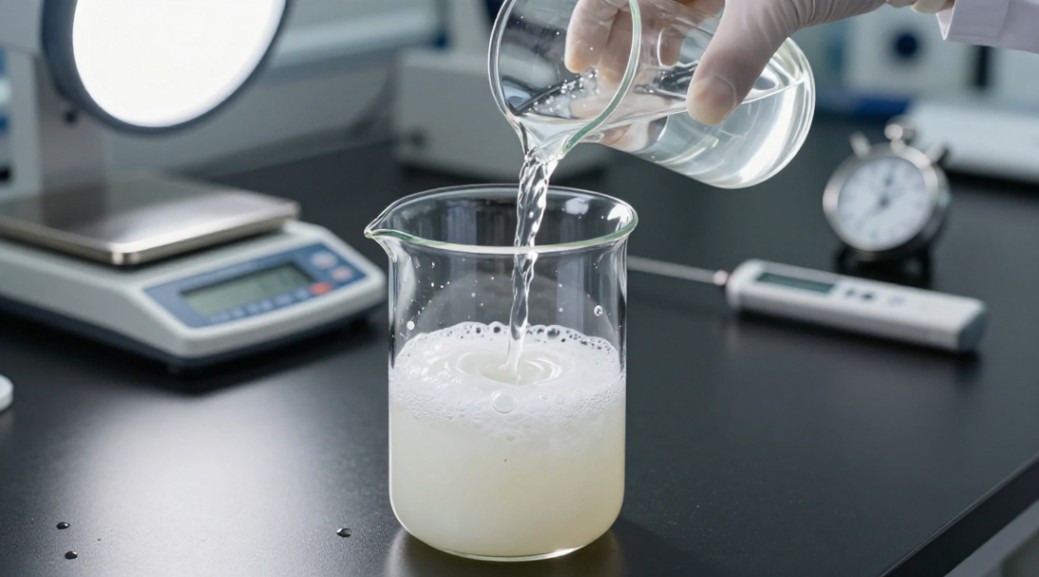

2. Never Guess the Dosage
“A little more for good measure” is a recipe for disaster. Over-dosing creates weak, watery foam that collapses. Under-dosing fails to achieve your target density. The correct dosage depends on your target density, cement type, and the specific agent. You must run small batch tests first. Record the exact weight of agent, water, and the resulting foam density. This is your formula. Stick to it.
3. Never Use a Low-Pressure “Bubbler” for Structural Work
The foam generation method is half the battle. Low-pressure systems that just “whisk” air into a diluted agent produce large, wet bubbles with poor stability. For high stability foam concrete, you need a high-pressure foam generator. It forces the agent solution through a precise nozzle, creating millions of tiny, dry, and incredibly resilient bubbles. The difference in the final concrete is night and day.
Building Success: A Simple, Safe Process
Let’s walk through the right way to do it. This process, using a quality protein-based foaming agent like our own StabilFoam Pro series, has never failed me.
- Precision Dilution: Dilute the concentrated agent with clean, cold water at the ratio specified on the technical data sheet. Mix thoroughly.
- Generate Dry Foam: Use a high-pressure generator (>6 bar). Adjust the air and solution intake to produce foam with a density 10-15% below your final target concrete density. The foam should feel dry, like shaving cream, not wet like soap suds.
- Gentle, Thorough Integration: Blend the dry foam into your cement slurry (sand, cement, water) using a slow-speed, high-shear paddle mixer. Mix for 2-3 minutes until perfectly homogeneous. No swirling streaks of foam or slurry.
- Immediate Placement: Place the mixed foam concrete within 15-20 minutes. Do not remix after placement.
Your Path Forward: Test, Don’t Guess
If you take one thing from my years of hard lessons, let it be this: your project’s viability depends on the stability of your air-void system. You cannot compromise on the agent that creates it. Don’t buy based on price per liter. Buy based on proven performance data and technical support.
Before your next pour, get samples. Conduct a foam stability test: generate foam and let it sit in a measuring cylinder for one hour. High-stability foam will lose less than 10% of its volume. Then, cast small test cubes. Check their density and strength. This small investment of time reveals everything. When you’re ready to test a truly reliable agent, our technical team can guide you through this exact validation process with samples of our StabilFoam Pro. Because seeing—and testing—is believing. Let’s build something that lasts.
Supplier
ConcreteAndMore is a trusted global supplier of high-performance concrete admixtures and construction chemicals. With years of industry expertise, we specialize in providing innovative solutions including polycarboxylate superplasticizers, concrete fibers, defoamers, foaming agents, and advanced aerogel thermal insulation products. If you are interested in concrete admixture, please feel free to contact us!