


Lightweight Concrete Additives | High-Performance Foaming Agents for Cellular Concrete

Hydroxypropyl Methylcellulose, or HPMC, is a cellulose ether admixture that fundamentally improves the fresh-state properties of cement render by functioning as a powerful water-retention and thickening agent. This chemical modification transforms a simple mortar from a mix prone to rapid water loss and stiff application into a pliable, cohesive, and workable material that adheres properly to vertical surfaces. For contractors and formulators, understanding HPMC is essential for achieving consistent, high-quality finishes with reduced labor effort and material waste.
The Core Mechanism: Water Retention Through Colloidal Film
At its core, HPMC works by physically manipulating the water within the cementitious matrix. Upon contact with water, its long-chain polymer molecules hydrate and uncoil, creating a protective colloidal network. This network effectively traps free water molecules. When mixed into cement render, this action significantly reduces the rate of water evaporation into porous substrates and the atmosphere. The retained water remains available for the critical process of cement hydration over a longer period. In essence, HPMC creates a reservoir of workability, preventing the premature stiffening that plagues renders mixed with plain water. A 2018 industry report by the Global Mortar Additives Consortium quantified this effect, noting that typical HPMC additions can increase water retention values from below 75% to over 95%, as measured by the filter paper method.
Tangible Impacts on Render Workability and Application
The retained water directly translates into measurable improvements in on-trowel performance. The first is enhanced plasticity. The mortar becomes buttery, allowing it to be spread easily without tearing or dragging. Second, it gains cohesiveness. This means the sand particles are held in suspension, preventing segregation and bleeding. Most critically for vertical application, this cohesive body dramatically reduces sagging. Render mixed with HPMC clings to the wall, allowing applicators to build up thicker layers in a single pass. Veteran applicators often describe the difference as “night and day.” As master plasterer James Kowalski noted in a trade journal interview, “A properly formulated render with HPMC gives you an extended open time. You’re not racing against the clock, which means you can focus on achieving a perfectly flat, tooled finish without panic.” This extended open time, often 30 to 90 minutes longer depending on dosage and ambient conditions, is a direct result of controlled hydration.
Practical Dosage, Mixing, and Interaction Considerations

| Viscosity Grade (mPa·s) | Typical Dosage (% of binder) | Primary Effect on Render |
|---|---|---|
| 400 – 4,000 | 0.1 – 0.2% | Improves workability and water retention with minimal viscosity increase. |
| 10,000 – 20,000 | 0.2 – 0.3% | Balanced workability and sag resistance for general vertical rendering. |
| 60,000 – 100,000 | 0.3 – 0.5% | High cohesion and anti-sag for thick, single-coat applications or overhead work. |
HPMC is generally compatible with other common render admixtures, but interactions exist. It works synergistically with air-entraining agents to improve freeze-thaw durability and plasticity. When used with superplasticizers (high-range water reducers), a sequential addition is often best: add the superplasticizer to the mixing water first to disperse, then incorporate the HPMC-dry mix. The primary trade-off is a potential delay in setting time and early strength development. This is a controlled, not a detrimental, effect. The render gains sufficient green strength to resist handling damage, while final cure strength is not compromised. In fact, improved hydration often leads to higher ultimate strength compared to a render where water evaporated prematurely.
Cost-Benefit and Final Render Quality
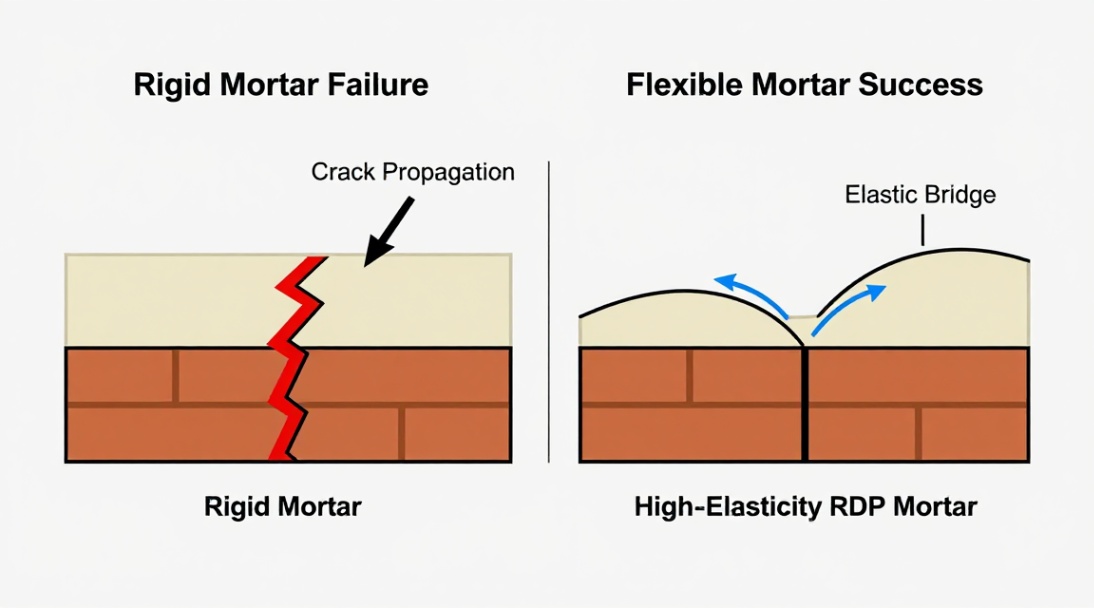
For contractors, the calculation is straightforward. Adding HPMC increases the material cost of the mortar by a small margin. This cost is offset multiple times over by labor efficiency gains—faster application, less rework, and reduced material waste from sagging or rejected batches. The final hardened render exhibits superior quality: significantly reduced plastic shrinkage cracking due to even moisture distribution, improved bond strength from better substrate wetting and adhesion, and a denser, smoother surface that requires less finishing effort. This approach is fundamentally superior to the outdated practice of simply adding excess water to improve workability, a method that guarantees weak, porous, and crack-prone results.
Today, HPMC is the backbone of nearly all high-quality premixed dry mortar products for rendering. Its reliable performance has made it indispensable for both factory production and informed on-site batching. For any professional seeking to optimize their cement render application, evaluating and incorporating a well-chosen HPMC product is a critical step. Start by consulting with your admixture supplier to select the correct viscosity grade for your specific project requirements, and conduct a small test batch to fine-tune the dosage for your local materials and climate. The improvement in workability and finished quality will be immediately apparent.
Supplier
ConcreteAndMore is a trusted global supplier of high-performance concrete admixtures and construction chemicals. With years of industry expertise, we specialize in providing innovative solutions including polycarboxylate superplasticizers, concrete fibers, defoamers, foaming agents, and advanced aerogel thermal insulation products. If you are interested in concrete admixture, please feel free to contact us!