


Könnyű betonadalékok | Nagy teljesítményű habképző szerek celluláris betonhoz

Az első alagsorom: A $50,000 Lesson in False Security
Ten years ago, Felügyeltem egy „korszerű” lakóépület pincefelöntését. A tulajdonos, hozzáértő mérnök, insisted on a premium konkrét waterproofing admixture for basements. We used the specified dosage. The slab was monolithic. No external membrane. ‘This stuff is the future,’ he said.

Eighteen months later, I was standing in six inches of víz. The admixture had failed. Not because it was defective, but because we ignored everything else that keeps water out. The owner lost his finished gym. I lost my reputation for that quarter.
Do not make his mistake. This article is not about the magic of chemistry. It is about the brutal physics of below-grade construction. Konkrét waterproofing admixture for basements egy erős eszköz, but used incorrectly, it is an expensive placebo.
The Critical Choice: Hydrophobic vs. Crystalline Admixtures
Most contractors grab the first off-the-shelf konkrét waterproofing admixture for basements. This is a mistake. For basement applications, you have two distinct chemical families. Your choice dictates your entire waterproofing strategy.
Below is a comparison of their mechanisms and how they fail in the real world of basement slabs and falak.
Hydrophobic Pore-Blocking vs. Hydrophilic Crystalline Admixtures
| Feature | Hidrofób (Pore-Blocking) | Hydrophilic (Crystalline) |
|---|---|---|
| Primary Mechanism | Waxes, szappanok, or silicones line the capillary pores. Water is repelled by surface tension. | Reactive chemicals use moisture to form insoluble crystalline needles that physically block pores and micro-cracks. |
| Behavior Under Hydrostatic Pressure | Effective at low to moderate head pressures. Can be overwhelmed if water pressure forces it past the hydrophobic barrier. | Superior. Crystals grow in the direction of water ingress, densifying the matrix against positive and negative hydrostatic pressure. |
| Re-activity with New Moisture | Passive. Once the hydrophobic barrier is disturbed or degraded, it cannot self-repair. | Active. Crystals remain dormant. If new water enters through a crack, the reaction activates again, sealing the breach. |
| Application for Basements | Suitable for slabs on grade with minimal ground water. Risky for deep basements below the water table. | Preferred for below-grade walls and footings subjected to continuous hydrostatic pressure. |
Here is the warning: Do not assume a crystalline admixture is the automatic answer. Ez az. But only if the concrete mix is designed for it. The crystals require water and a specific chemical environment to form. A high-slag or high-fly-ash mix can starve the reaction. You must verify compatibility with your ready-mix supplier before the truck arrives.
A 5 Fatal Execution Errors That Destroy Waterproofing
Admixtures are not magic dust. They are chemical modifiers that require perfect execution. I have seen these five mistakes kill a waterproofing system more often than material failure.
- Ignoring the Water-Cement Ratio: A concrete waterproofing admixture for basements cannot fix a mix with a water-cement ratio above 0.50. Above this, you have interconnected capillary voids too large for any admixture to block effectively. Your target must be 0.45 vagy alacsonyabb. No exceptions. This will hurt slump. That is what superplasticizers are for.
- Poor Consolidation: Honeycombing is a death sentence. The admixture only works in the paste. If you have rock pockets, you have direct water paths. Guaranteed. Use appropriate vibration for every cubic yard of a wall form.
- Inadequate Curing: This is the #1 hidden killer. Crystalline admixtures need water to grow. If you let the concrete dry out in the first 7 napokon, you kill 50% of the waterproofing potential. Wet cure or use a membrane-forming curing compound. Do not use a sheet that will trap bleed water.
- Ignoring Joints and Cracks: No admixture bridges a through-crack wider than 0.4 mm. Egyik sem. You must design for cracking. Install properly spaced waterstops at construction joints. Saw-cut control joints and seal them with a flexible polyurethane. Your concrete waterproofing admixture for basements keeps the concrete itself watertight. It does nothing for the cold joint between the wall and the slab.
- Mixing with Incompatible Admixtures: Calcium chloride accelerators are the enemy. They can disrupt the crystal formation cycle. Lágyítók (nagy hatótávolságú vízcsökkentők) are generally safe, but you must test for slump retention and set time with your specific concrete waterproofing admixture for basements. A simple 30-minute lab test can save you a catastrophe.
Cost Analysis: Admixture vs. External Membrane
A common logic trap: ‘The admixture is expensive, but it saves me the cost of a membrane.’ True? Néha. But often, it is a false economy.
Below is a logical cost-value breakdown based on project risk. This assumes a standard 1,500 sq ft basement slab and wall.
| Strategy | Relative Cost Increase (Over Standard Concrete) | Risk Profile | Scenario Fit |
|---|---|---|---|
| Standard Concrete + External Bituminous Membrane | Bázis (100%) | Mérsékelt (membrane damage risk) | Shallow basement, low water table, granular backfill |
| Crystalline Admixture ONLY (No external membrane) | +15-20% for admixture (Savings on membrane labor) | Magas (requires perfect execution, repedések, ízületek) | Confined site, difficult membrane access, owner accepts risk |
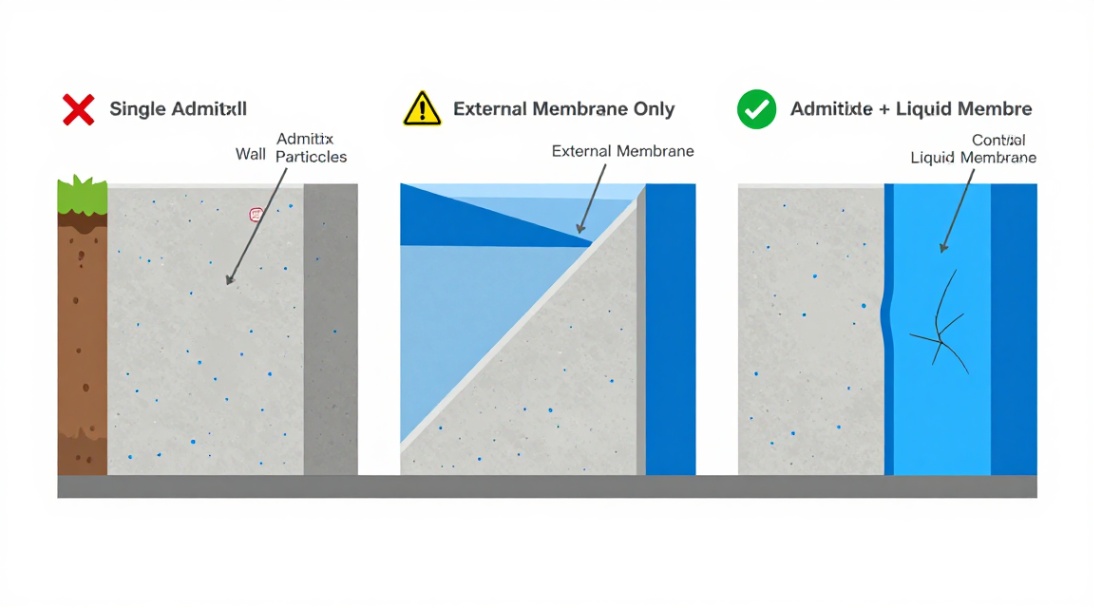
| Crystalline Admixture + Taped/Fluid-Applied Liquid Membrane at Joints | +25-30% | Alacsony (Best risk-reward) | Deep basements, high water table, finished living space |
Az adatok egyértelműek. Relying on a concrete waterproofing admixture for basements alone is a high-risk gamble. The optimal solution is to use the admixture to make the concrete itself a rock-solid barrier, and then address the structural weak points (joints and cracks) with a targeted liquid membrane system. You get the redundancy of two independent systems.
Testing and Standards: The ASTM C494 Type S Trap
Many admixtures are sold as meeting ASTM C494 Type S (Special Performance). This standard is broad. It does not guarantee waterproofing performance. It just means the admixture does something special, not necessarily related to waterproofing.
Demand testing data specific to reduced water permeability under pressure. Look for test results following DIN 1048 (water penetration depth) or CRD C48 (water permeability under pressure). If the manufacturer cannot provide data on hydrostatic pressure resistance for a concrete waterproofing admixture for basements, do not buy it. Időszak.
Következtetés: Stop Gambling on Your Foundation
You now know the physics. You see the common errors. You understand the real costs. A concrete waterproofing admixture for basements is not a simple yes/no decision. It is a precision tool.
If you are serious about a dry basement, do not take a gamble on a single admixture. Use a proven crystalline system, enforce a maximum 0.45 w/c ratio, and always seal your construction joints. The cost of water damage is a thousand times higher than the cost of doing it right the first time.
The Hard Truth: Most ready-mix suppliers offer a ‘waterproofing admixture’ option. Do not blindly accept it. Ask for the specific brand. Ask for the hydrostatic test data. If they cannot deliver, walk away.
My Recommendation: I have tested dozens of products. For deep basements, I specify and recommend Krystol Internal Membrane (KIM) by Kryton. It is the only crystalline admixture I have seen consistently re-seal micro-cracks under sustained hydrostatic pressure over a 10-year period. Pair it with their waterstop and joint treatment. Igen, it costs more. A leaking basement costs far more.
This is not an ad. It is a warning. Do your research. But if you want a single manufacturer with a track record that stops me from getting wet socks, that is the one.
Action Step: Before your next concrete order, call your supplier. Tell them: “I am using a crystalline waterproofing admixture. My water-cement ratio will be 0.45. I need a compatible plasticizer. Can you deliver that mix design?” If they hesitate, find a new supplier. Your basement depends on it.
Szállító
A ConcreteAndMore a nagy teljesítményű betonadalékanyagok és építőipari vegyszerek megbízható globális szállítója. Több éves iparági tapasztalattal, innovatív megoldások nyújtására specializálódtunk, beleértve a polikarboxilát szuperlágyítókat, betonszálak, habzásgátlók, habképző szerek, és fejlett airgel hőszigetelő termékek. Ha érdekel a betonadalékanyag, kérjük, forduljon hozzánk bizalommal!