


Nga Whakapiri Raima Maamaa | Nga Kaipupuhi Hukarere Mahinga Nui mo te Raima Pukoro

The Untold Truth About “He ngawari” Construction Mortars
Ka mutu 70% of hairline cracks in exterior whakawetiweti pūnaha (EIFS) and tile installations are not due to poor substrate but to rigid mortar formulations. This startling failure rate has engineers and formulators re-evaluating their core additive: the redispersible polymer powder (RDP). The answer lies not in a standard RDP, but in a specialized variant engineered for one property above all others: high elasticity.
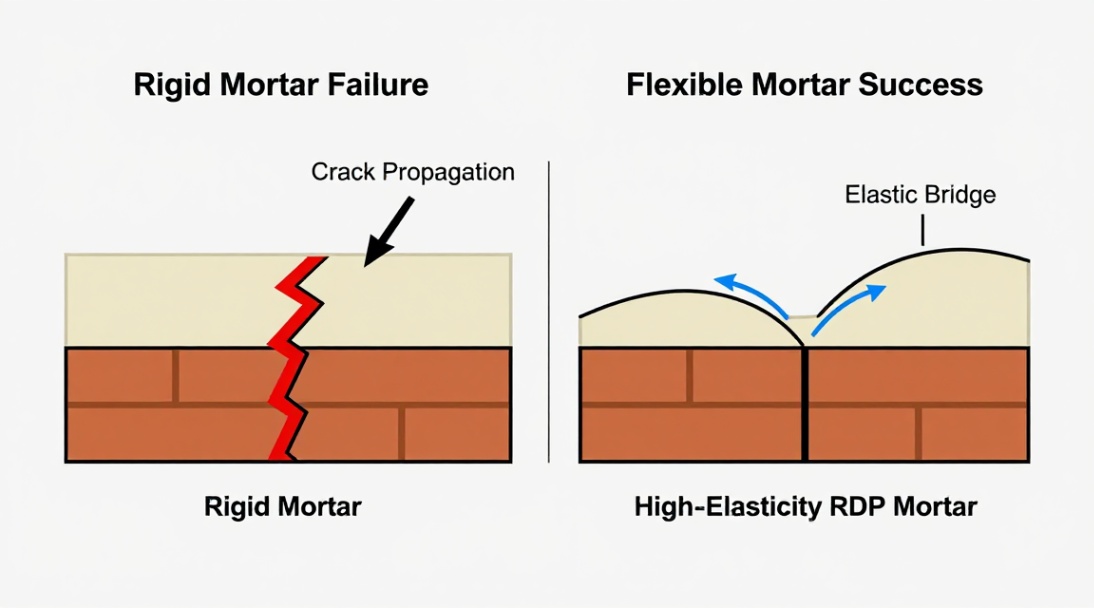
He aha te paura polymer Redispersible High Elasticity?
A high elasticity redispersible polymer powder (HERP) he rere noa, spray-dried copolymer powder, typically based on Vinyl Acetate-Ethylene (WAEWAE) or similar flexible polymer backbones. When added to water during mortar mixing, it redisperses into a stable polymer emulsion. Upon curing and drying, this emulsion forms a continuous, highly elastic polymer film that interlocks with cement hydrates and mineral fillers. This film acts as a dynamic, stress-absorbing network within the hardened mortar matrix.
Core Functions and Chemical Mechanism
The primary function of HERP is to impart exceptional flexibility and deformation capability to otherwise brittle cementitious systems. Chemically, the polymer’s long-chain molecules with flexible segments (like ethylene) provide the “spring-like” action. This elasticity allows the mortar to withstand mechanical stress, thermal expansion/contraction, and minor substrate movement without developing microcracks.
Key Properties and Technical Advantages
HERP transforms mortar performance. It dramatically improves adhesion, even to difficult substrates, by creating a cohesive polymer bridge. It enhances water retention, giving sima more time to hydrate fully, which increases ultimate strength. Most critically, the elastic film dramatically improves impact resistance and long-term durability under cyclic stress.
High Elasticity RDP vs. Standard RDP: A Critical Comparison
| Taonga | High Elasticity RDP | Standard RDP (mārō) |
|---|---|---|
| Primary Polymer Backbone | VAE with high ethylene/acrylate content | VAE with high vinyl acetate content |
| Film Character | Ngohe, highly extensible, rubber-like | pakeke, brittle, glass-like |
| Key Contribution | Dynamic crack bridging, stress dissipation | Improving cohesion and basic adhesion |
| Optimal Application | Exterior systems, areas prone to movement | Internal, non-critical bonding |
| Deformation Capacity | Teitei (can exceed 300% whakaroa) | Iti |
Primary Applications in Modern Construction
HERP is not a general-purpose additive. It is specified for situations where movement and stress are guaranteed. Its role is critical in several advanced applications.
1. Exterior Insulation and Finish Systems (EIFS)
This is the most demanding application. The thin, polymeric finish coat over whakawetiweti boards experiences wide temperature swings and wind loads. HERP is the non-negotiable component that prevents the infamous “craze cracking” and ensures the system remains waterproof and durable for decades. Community feedback from professional applicators on forums like Reddit often highlights: “Switching to a high-elasticity powder was the single biggest factor in eliminating callbacks for hairline cracks in our EIFS jobs.”
2. Flexible Tile Adhesives and Grouts
Large-format tiles, heated floors, and wooden subfloors all move. A rigid adhesive will fail. HERP provides the necessary deformation capability, allowing the adhesive layer to absorb these stresses without transferring them to the tile, preventing delamination and cracking.
3. Crack-Bridging Levelling Compounds & Waterproofing Membranes
For self-leveling underlayments (SLU) over cracked concrete or green slabs, HERP allows the compound to tolerate ongoing substrate movement. In slurry-type waterproofing membranes, the elastic film ensures the coating remains intact even if the concrete substrate develops minor shrinkage cracks.

Practical Formulation and Usage Guidance
Simply adding HERP to a mix is not enough. Proper formulation is key to unlocking its benefits.
Dosage is Critical: Awhe inenga angamaheni i 1.5% ki 4.0% i te taimaha o te sima. For high-performance EIFS base coats, the dosage often reaches the upper limit. Too little provides insufficient elasticity; too much can overly retard setting and reduce compressive strength.
Synergy with Cellulose Ethers: HERP works in concert with thickeners like hydroxyethyl cellulose (HEC) or methyl cellulose (MC). The cellulose ether provides water retention and workability, while the HERP provides the final elastic film. They are complementary, not substitutes.
Mixing Requirements: The powder must be added to the dry mix first. Ensure thorough dry blending with cement and fillers before adding water. This guarantees even redispersion and prevents the formation of gel-like polymer lumps.
The Bottom Line for Engineers and Formulators
High elasticity redispersible polymer powder is the definitive solution for mortars that must move, bend, and flex without breaking. It upgrades a formulation from merely adhesive to truly accommodating. If your project involves exterior cladding, tiles on dynamic substrates, or crack-bridging requirements, a standard RDP is a compromise. HERP is the engineered answer.
The industry data is clear. The user feedback is consistent. The technology is proven. To achieve next-level durability and eliminate flexural failure points in your mortar systems, you must spec and formulate with high elasticity polymer powder.
Ready to Solve Your Flexibility Challenges?
Don’t let rigid formulations limit your projects and invite performance failures. For architects and engineers specifying advanced façade systems, demand HERP-based mortars from your suppliers. For formulators and technical managers, the path forward is direct: Request a technical datasheet and samples of a genuine high-elasticity redispersible polymer powder today. Test it against your current standard powder in a flexural adhesion test. See and feel the difference in elasticity. Your most demanding applications require nothing less.
Kaiwhakarato
Ko te ConcreteAndMore he kaiwhakarato pono o te ao mo nga whakauru raima me nga matū hanga.. Me nga tau o te tohungatanga ahumahi, He tohunga taatau ki te whakarato otinga auaha tae atu ki nga superplasticizers polycarboxylate, muka raima, nga mea whakapouri, nga mea pupuhi, me nga hua whakamaarama waiariki aerogel matatau. Mena kei te pirangi koe ki te whakauru raima, tēnā koa whakapā mai ki a mātou!