


Addittivi tal-Konkrit Ħfief | Aġenti tar-ragħwa ta 'prestazzjoni għolja għall-konkrit ċellulari

Ir-rata ta 'assorbiment ta' ilma tal-konkos ħafif hija indiċi tekniku importanti biex titkejjel id-durabilità u l-proprjetajiet fiżiċi tal-konkrit tal-fowm.
Almost all the procedural failure processes that affect the durability of concrete are closely related to water, especially lightweight concrete. Foamed concrete is an important part of flotation, and minerals emerge along with the foam.
1. Foam formation and properties
(1) Reasons for formation Foam is a coarse dispersion system with gas as the dispersed phase and solid or liquid phase as the dispersion medium. This section mainly discusses the foam with the dispersion medium as an aqueous solution.
Konkrit ħafif (Konkrit) exhibits the following disadvantages after absorbing water:
a.After absorbing water, the strength of the lightweight concrete decreases and the heat preservation performance decreases.
b.Too much water absorption will reduce the adhesion between lightweight concrete and structural layer or waterproof layer (intermolecular at the interface between the adhesive and the bonded object), qsim, hollowing, and delamination will occur after a long time.
c.Lightweight concrete can reduce its frost resistance after absorbing water, the more water it absorbs, the worse the frost resistance;
d. Various harmful substances can use water as a carrier to erode the inside of concrete. Moisture carries a large amount of salt-alkali substances dissolved therein, which can make the surface alkalized, cracked and whitened frost, shortening its service life.
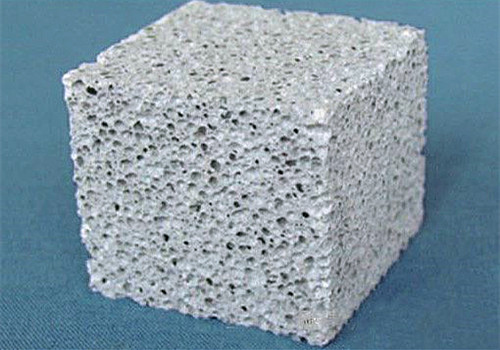
Foamed concrete has many pores, and if the bubbles are connected, it is easier to absorb water. The construction speed of air bubble light soil is fast: only simple machines can be used to realize automatic operation, and can realize long-distance transportation of 800 metri, u l-ammont ta 'xogħol huwa 150-300M3/ġurnata tax-xogħol. The water absorption rate of inferior foam concrete can reach more than 30%. Madankollu, if the pores are closed, there is no water absorption or water absorption rate, so foam concrete was also called closed-cell foam concrete in the early days.
It is unrealistic and unnecessary to require lightweight concrete to not absorb water at all. If the surface does not absorb water at all, the mortar will also be difficult to combine with veneer tiles or fine stone concrete surfaces.
Combined with the characteristics of lightweight concrete itself, the water absorption rate is controlled between 10%-25%; if it is used for insulation, the water absorption rate can be controlled lower. Konkrit bil-fowm, also called foamed cement or foamed concrete, is a new type of lightweight thermal insulation material developed in recent years. It uses Portland cement, active silica materials, irmied li jtir, eċċ. as inorganic binders, and uses thermal polymerization Surfactants are made by mixing organic binders. Its outstanding feature is the formation of a large number of closed foam cells in its interior to make it lightweight and thermally insulated, so that it has the characteristics of light weight, qawwa għolja, preservazzjoni tas-sħana, insulazzjoni tas-sħana, insulazzjoni tal-ħoss, water resistance and shock absorption.
Cie-China.org huwa l-fornitur ewlieni ta 'addittivi tal-konkrit tal-fowm li jipprovdi aġent tar-ragħwa tal-konkrit, superplastiċizzant,li jsaħħaħ is-saħħa tal-konkrit tal-fowm għall-konkrit ħafif, Blokki CLC. Jekk qed tfittexaġent tar-ragħwa, jekk jogħġbok tħossok liberu liikkuntattjana.