


Aditivos para concreto leve | Agentes espumantes de alto desempenho para concreto celular

O 40% Permeability Drop You’re Probably Ignoring
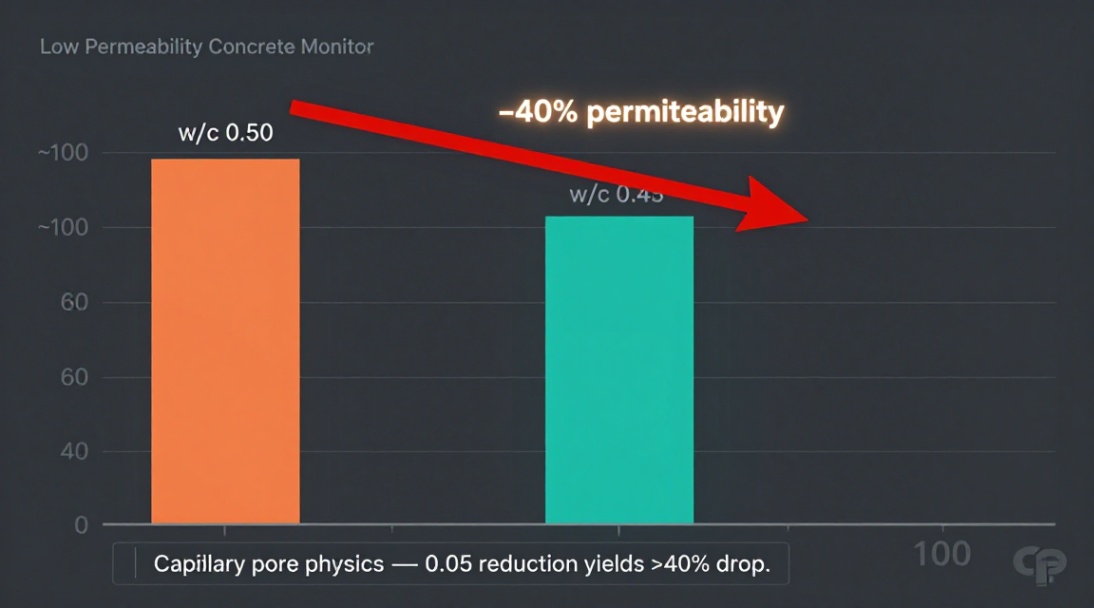
Here’s a number that should make you stop mixing: um 0.05 reduction in water-cement ratio can cut concrete permeability by over 40%. That’s not a theory. That’s capillary pore physics. Ainda, we keep seeing spec sheets where the water reduzindo admixture for low permeability concrete is treated like a cheap afterthought.
We’ve all been there. The pump truck is waiting. The crew is staring. The batch plant sends a load that looks stiff. So you add more water. Or worse, you dump in a whole extra gallon of superplasticizer hoping it fixes everything. Stop. That’s where the nightmare begins.
Let’s walk through the real-world traps. Sem fofo. Just the hard-earned lessons de two decades of fixing bad mixes.
1. What Exactly Is a Water Reducing Admixture for Low Permeability Concrete?
In simple terms: it’s a chemical that lets you reduce mixing water by 5% para 30% without making the concreto unworkable. Lower water means lower w/c ratio. Lower w/c means fewer capillaries. Fewer capillaries means water, cloretos, and sulfates can’t sneak through.
Many users on Reddit have posted about using a mid-range water reducer on a basement wall and still getting dampness. Por que? They used the wrong type. For real low permeability, you need more than just a standard Type A. You need a alto-range water reducer (Type F or G) if you’re targeting a w/c below 0.40.
2. Why Does Low w/c Matter So Much?
Because permeability is not a linear function of w/c. At a w/c of 0.50, you have a highway of pores. No 0.35, those pores are mostly disconnected. The water reducing admixture for low permeability concrete is your tool to get there.
But here’s the trap: over-reduction. We’ve seen mixes with a w/c of 0.28 that had zero bleed water. That sounds great until the surface plastic shrinkage cracks open like a dry lake bed. You need some bleed to finish. Don’t chase a number. Chase a specification.
3. What Are the Types of Water Reducing Admixtures?
Pick the wrong one and you’ll either get no benefit or a set-time disaster. Here’s the breakdown:
| ASTM Type | Redução de Água | Best For Low Permeability |
|---|---|---|
| UM (Normal) | 5-10% | Only for minor improvements |
| F (High Range) | 12-25% | Excellent for w/c 0.35-0.40 |
| G (High Range, Retarding) | 12-25% | For hot weather or long hauls |
If you’re doing a water tank or a bridge deck exposed to deicing salts, we don’t recommend Type A. Go straight to Type F or G. The extra cost pays for itself in durability.
4. How Does It Affect Cement Hydration?
Here’s the technical part. Water reducers are surfactants. Eles disperse cement particles by breaking up agglomerations. This exposes more surface area for hydration. So you get higher early strength without adding cement.
But over-dosing is a real risk. We’ve seen a job where the ready-mix driver added an extra quart of superplasticizer on site. The concrete didn’t set for 18 horas. The finishers walked off. The slab was a mess. Stick to the manufacturer’s dosage within +/- 10%. No more.
5. What’s the Optimal Dosage for Low Permeability?
There’s no one-size-fits-all number, but here’s a rule of thumb from field experience:
- Alvo: 0.38 para 0.42 w/c ratio.
- Dosagem: Começar em 4-6 oz per 100 lbs of cement for Type F. Adjust up to 10 oz max.
- Aviso: Acima 10 oz, you risk segregation and excessive retardation.
Always do a trial batch. The ‘floppy’ teste (visual slump) is not a test. Use a slump cone and measure exactly.
6. Are There Compatibility Issues with Other Admixtures?
Sim, absolutely. This is where many projects fail. You cannot just dump in an air-entraining agent and a water reducer and hope they play nice.
- Conflict: Some high-range water reducers can reduce air content by 1-2%. You’ll need to bump up the AEA dosage.
- Sequence: Add the water reducer first, then the air entrainer. Never mix them neat in the same tank.
- Retarder combo: If you use Type G, you don’t need a separate retarder. Double retardation ruins finishing time.
One contractor on Reddit described adding a retarder to a Type G mix on a cold night. The concrete was still soft the next morning. They had to tear it out. Read the compatibility data sheet.
7. Aplicações do mundo real: Where This Mix Shines
The water reducing admixture for low permeability concrete is not a luxury. It’s a necessity for:
- Water tanks and reservoirs: Leakage is unacceptable.
- Basements and below-grade walls: Hydrostatic pressure finds every pore.
- Decks de ponte: Chloride penetration from deicing salts causes rebar corrosion.
- Sulfate-exposed structures: Wastewater plants, ambientes marinhos.
In every case, we’ve seen a properly dosed blend of Type F water reducer and a low-alkali cement produce concrete with a rapid chloride permeability rating below 1000 coulombs. That’s ‘very low’ by ASTM C1202.
8. What Are the Drawbacks You Must Watch For?
Let’s be honest. No admixture is magic. Here are the real risks:
- Increased shrinkage: Higher cement paste volume (due to lower water) can increase drying shrinkage. Use a shrinkage-reducing admixture if needed.
- Setting time changes: Type F accelerates slightly. Type G retards. Plan your pour schedule accordingly.
- Over-dosing risks: Segregation, bleeding, crusting, and strength loss. Respect the dosage window.
We had a job where the concrete was too dry for finishing because the water reducer was over-effective. The finishers had to use a spray-on finishing aid. That costs money and time.
9. How Do You Test If You Actually Achieved Low Permeability?
Don’t just guess. Use these standard tests:
- Rapid Chloride Permeability (RCP) – ASTM C1202: Measures total charge passed. Target below 1000 coulombs for low permeability.
- Absorção de Água – ASTM C642: Good indicator of pore volume.
- Sorptivity – ASTM C1585: Measures rate of water absorption by capillary suction.
Many specifiers now require RCP results before accepting a mix. If you haven’t tested yours, you’re flying blind.
10. Sustainability: Reduce Cement, Not Performance
Here’s the hidden win. With a high-range water reducer, você pode reduce cement content by 10-15% while maintaining the same w/c ratio and strength. That lowers CO2 footprint without sacrificing low permeability.
We’ve done it on multiple projects. Replace 100 lbs of cement with a properly dosed water reducer. Same strength. Same permeability. Lower cost. Greener concrete.
Our Recommendation: The Admixture We Trust
After testing dozens of brands, we keep coming back to Xypex Admix C-1000 for critical low-permeability applications. It’s a blend of high-range water reducer and a crystalline waterproofing agent. It’s not just about reducing water-it’s about plugging the pores that remain.
Use it at 2% em peso de cimento. Your rapid chloride permeability will drop below 500 coulombs. We’ve seen it on parking garages and water treatment plants.
Stop using generic naphthalene-based water reducers on critical structures. Upgrade your mix.
Click here to order Xypex Admix C-1000 now. Stock is limited. Don’t let another pour fail.
Fornecedor
ConcreteAndMore é um fornecedor global confiável de aditivos para concreto e produtos químicos para construção de alto desempenho. Com anos de experiência no setor, somos especializados em fornecer soluções inovadoras, incluindo superplastificantes de policarboxilato, fibras de concreto, antiespumantes, agentes espumantes, e produtos avançados de isolamento térmico de aerogel. Se você estiver interessado em aditivo para concreto, não hesite em contactar-nos!