


Aditivos para formigón lixeiro | Axentes espumantes de alto rendemento para formigón celular

O 3 AM Pour That Went Wrong
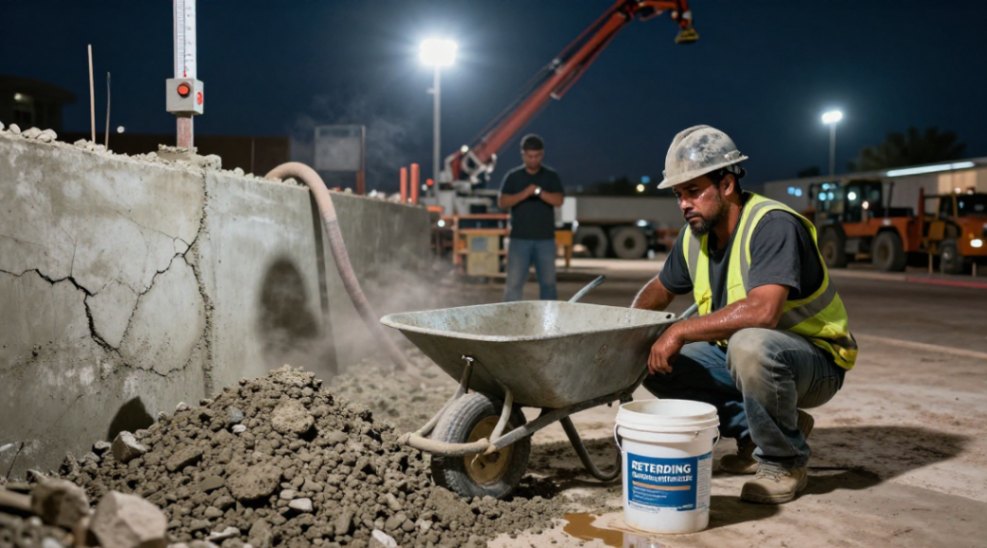
Imaxínate isto: É 3 AM en Phoenix, xullo. O aire aínda está a 95 °F. Estamos colocando unha base de alfombra enorme. Chega o primeiro camión, afundimento is perfect at 8 polgadas. By the time the pump reaches the form, the concrete looks like dry gravel. The finishers are screaming. The foreman is pacing. Todos estivemos alí. That’s the moment we realize standard superplasticizers don’t cut it in extreme heat. We need a specialist. We need a retarding type superplasticizer for hot weather.
What Is a Retarding Type Superplasticizer?
Let’s get the chemistry out of the way. A standard superplasticizer (gama alta auga redutor) disperses cement particles. It gives us flow without adding water. But in heat, that hydration reaction accelerates. Slump loss happens fast. A retarding type superplasticizer for hot weather does double duty. It contains molecules that physically block the hydration sites on cement grains. Think of it as a temporary shield. It delays the chemical reaction that turns liquid concrete into solid rock.
These admixtures are typically made from modified lignosulfonates, ácidos hidroxicarboxílicos, or synthetic polymers like polycarboxylate ethers. The retarding component is often a sugar derivative or a phosphate. The magic is in the balance. We delay the set without killing the early strength gain entirely.
Como funciona: The Mechanism in Simple Terms
We need to visualize what happens at the microscopic level. Cement particles are covered with a film of water. En condicións normais, that film allows chemical reactions to begin within minutes. Heat speeds this up. The retarding superplasticizer adsorbs onto the surface of the cement grains. It forms a thin, impermeable layer. This layer slows down the dissolution of ions (calcium, silicate, aluminate) that kick-start the setting process.
Ao mesmo tempo, o superplastificante part repels particles from each other. They don’t clump. We get a fluid mix that stays fluid for longer. The combination of steric hindrance (physical block) and electrostatic repulsion (push apart) gives us both workability retention and delayed setting.
Why This Matters for Your Next Job
If you are placing concrete when ambient temperature exceeds 30°C (86°F), you are fighting a losing battle with standard admixtures. Your slump drops 1 inch every 10 minutos. By the time the concrete hits the forms, it’s unworkable. O retarding type superplasticizer for hot weather buys you time. Non é maxia. It’s chemistry.
Benefits Specific to Hot Weather Concreting
We see three clear wins when we use the right product. Primeiro, preventing slump loss. We can maintain a workable mix for 60 a 90 minutos, sometimes longer. Segundo, avoiding cold joints. In large pours, where the next truck arrives 30 minutes after the first, we need the first batch to still be fluid. Terceiro, controlling the heat of hydration. By delaying the initial reaction, we spread out the temperature rise. That reduces thermal cracking risk in thick sections.
- Retención de caída: Keeps concrete workable from truck to pump to form.
- Extended set time: Gives finishers time to level and texture.
- Reduced water demand: Lower water-cement ratio means higher strength.
Dosificación: Zona Goldilocks
Here’s where experience matters. Too little retarding superplasticizer, e non obtén ningún beneficio. Demasiado, and the concrete doesn’t set for 24 horas. We are talking about over-retardation. The dosage is highly sensitive to temperature. At 30°C, a typical dose works. At 40°C, you might need to increase it by 50%. But if the temperature drops suddenly (a summer thunderstorm), that same dose will cause a delay that kills your schedule.
We always recommend starting at the manufacturer’s mid-range dose. Then adjust based on site conditions. Keep a log. Track ambient temperature, concrete temperature, and slump loss over time. That data is gold.
Compatibilidade: Not All Cements Play Nice
This is a common headache. A retarding type superplasticizer for hot weather might work perfectly with Type I cement but fail with Type III (high early strength) or cement with high C3A content. C3A reacts fast. Some retarders are not powerful enough to block it. We have seen cases where the mix sets in 20 minutes despite a high dose.
Tamén, be careful with other admixtures. Axentes incorporadores de aire, aceleradores, or even some viscosity modifiers can interfere. The rule of thumb: test all admixtures together in a trial batch before the big pour. Do not assume they are compatible. Waste a yard of concrete on a test, non 100 yards on the job site.
Desvantaxes: The Other Side of the Coin
We must be honest. There are downsides. Prolonged finishing time is the biggest. If the concrete doesn’t set, finishers can’t work it. They stand around waiting. Iso custa cartos. Tamén, early strength can be lower. Ás 24 horas, strength might be 60% of what a non-retarded mix achieves. That means form stripping is delayed. You need to plan for this in your schedule.
Over-retardation is the nightmare scenario. If the concrete stays plastic for 48 horas, the surface can become soft, dusty, and prone to plastic shrinkage cracking. We have seen slabs ruined because the finisher added water to the surface, thinking it would help, but it only made things worse.
Aplicación: The Right Way to Add It
Do not just dump it on top of the aggregate. O retarding type superplasticizer for hot weather should be added to the mixing water or at the concrete plant after all other ingredients are in the mixer. Adding it to dry materials can cause flash set or uneven distribution. If you are adding it on site (in the truck), add it slowly while the drum is mixing fast. Let it mix for at least 5 minutos. Take a slump test. Non adiviñas.
For long-distance transport, consider adding a portion at the plant and a second dose at the job site. This gives you a two-stage retardation. It keeps the concrete fluid during the drive and then again during placement.
Quality Control: Test the Slump, Not the Clock
We need to measure. A simple slump cone test every 30 minutes tells you everything. Plot it on a graph. If the slump drops from 8 a 4 in the first 15 minutos, tes un problema. The dosage is wrong, or the cement is too reactive. If the slump stays at 7 for an hour, you are in the sweet spot.
Tamén, check the concrete temperature. If it rises above 35°C (95°F), you risk flash set regardless of the admixture. Use ice in the mixing water. Cool the aggregates. Shade the trucks. The admixture helps, but it cannot overcome extreme heat alone.
Storage in the Heat: Keep It Cool
The admixture itself is temperature sensitive. Do not store drums in direct sunlight. Keep them in a shaded area or an insulated container. The liquid can degrade if it gets above 50°C. Performance drops. We have seen drums left on a black asphalt parking lot in August. The liquid inside was basically useless. Treat it like a perishable material.
When to Choose This Over Standard Alternatives
Standard superplasticizers (like naphthalene or melamine based) can reduce water, but they don’t delay set. Set-retarding admixtures (like sugar or citric acid) can delay set, but they don’t improve workability. O retarding type superplasticizer for hot weather is the hybrid. Use it when you need both: long slump life and delayed set. This means large infrastructural pours (pontes, presas, cimentos), concrete transported over 45 minutes in hot conditions, and continuous placement where multiple trucks must match workability.
Do not use it for small slabs where you can place and finish in 30 minutos. It’s overkill and will slow you down.
Final Thoughts
We have learned the hard way. Hot weather concrete is not a job for standard admixtures. It demands a specialist. The retarding superplasticizer is that specialist. It gives us control over a process that wants to run wild. But it requires respect. We must test, measure, and adjust. There is no universal dose. Every job is different. Treat every pour as a learning opportunity. Build your data, share it with your team, and never assume the mix will behave the same way twice.
Provedor
ConcreteAndMore é un provedor global de confianza de aditivos de formigón de alto rendemento e produtos químicos para a construción.. Con anos de experiencia no sector, Somos especializados en ofrecer solucións innovadoras, incluíndo superplastificantes de policarboxilato, fibras de formigón, antiespumantes, axentes espumantes, e produtos avanzados de illamento térmico de aeroxel. Se estás interesado na mestura de formigón, póñase en contacto connosco!