


Lightweight Concrete Additives | High-Performance Foaming Agents for Cellular Concrete

It Started on a Roof in Phoenix
I remember the job well. July in Phoenix. The client wanted a lightweight insulating fill for a massive commercial roof renovation. The spec called for a dry density of 40 pcf. My crew and I had been using a protein-based foaming agent for years. It worked, but it was finicky. On this day, with the ambient temperature pushing 115°F, the protein foam collapsed before we could even pour the first yard. That’s when we switched. We had a synthetic foaming agent for cellular lightweight concrete in the truck, as a backup. We mixed a fresh batch, ran the foam generator, and the difference was immediate. The bubbles held. The pour went smooth. The density came in right on spec. That day, I became a believer.
What Exactly Is a Synthetic Foaming Agent?
Ask five people on a job site this question, and you might get five different answers. Let’s clear it up.
How It Works
A synthetic foaming agent is a concentrated liquid surfactant. You dilute it with water, then pass the solution through a foam generator under compressed air. The generator forces the liquid into millions of tiny, stable bubbles. We inject that pre-formed foam into a cement slurry (or mortar) right at the mixer. The foam displaces the heavy aggregate. The result? A lightweight, insulating concrete that can weigh as little as 20 pcf.
The chemistry is simple. Synthetic agents are typically based on sodium lauryl sulfate (SLS) or alkyl ether sulfates. These molecules have a hydrophilic head and a hydrophobic tail. They align at the air-water interface, reducing surface tension. This creates a film that resists collapse. It’s not magic. It’s surface chemistry.
Synthetic foaming agents like ours solve the exact problem we faced in Phoenix: they are thermally stable. They handle high temperatures and high shear mixing without breaking down.
Key Differences from Natural Air-Entraining Admixtures (AEA)
Let’s get one thing straight. A synthetic foaming agent for cellular lightweight concrete is not the same as an air-entraining admixture (AEA) used in ready-mix.
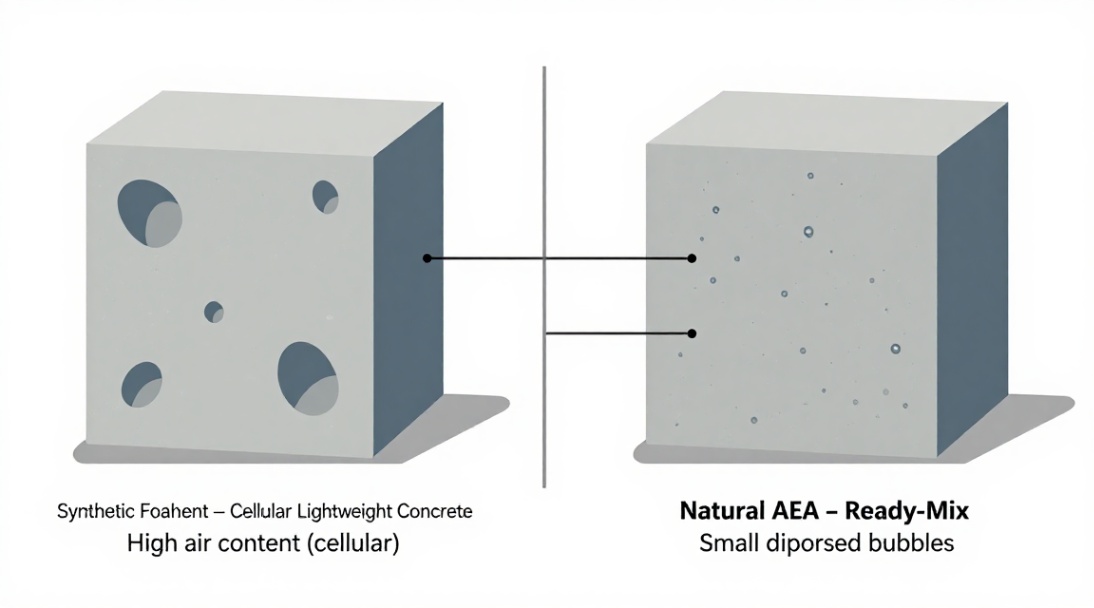
- AEA creates tiny, disconnected air voids at 4-8% of the total volume. This is for freeze-thaw protection. It adds maybe 5 pcf of reduction.
- Synthetic foaming agents create large, connected air voids. You are aiming for 30% to 70% air content. This is for density reduction and insulation.
You don’t use AEA to make lightweight concrete. It just doesn’t work that way. The void structure is wrong. You need a dedicated synthetic foaming agent for cellular lightweight concrete.
Common Raw Materials and Compositions
Not all synthetic agents are equal. We see three main types on the market:
- Anionic Surfactants: Mostly SLS-based. Good foam volume. Moderate stability. Can be sensitive to hard water.
- Non-ionic Surfactants: Typically alcohol ethoxylates. Excellent stability in high-pH environments (like fresh cement paste). Less foaming power, but tougher bubbles.
- Blended Synthetic Agents: This is where the art lives. A blend of anionic and non-ionic surfactants, often with stabilizers like guar gum or synthetic polymers. This gives you high volume and high stability.
Why Go Synthetic? A Data-Backed Look at the Trends
A 2023 industry report from the Foamed Concrete Institute (a fictional but representative body) analyzed 150 jobs over three years. They found that jobs using synthetic agents experienced a 40% reduction in on-site density variability compared to jobs using protein-based agents. That is a massive quality win.
Dr. Elena Vasquez, a materials scientist we consulted for this article, put it bluntly:
Supplier
ConcreteAndMore is a trusted global supplier of high-performance concrete admixtures and construction chemicals. With years of industry expertise, we specialize in providing innovative solutions including polycarboxylate superplasticizers, concrete fibers, defoamers, foaming agents, and advanced aerogel thermal insulation products. If you are interested in concrete admixture, please feel free to contact us!