


Lightweight Concrete Additives | High-Performance Foaming Agents for Cellular Concrete

It Started on a Roof in Phoenix
I remember the job well. Hulyo jar Phoenix. Ar cliente mi ne 'nar relleno aislante ligero pa 'nar renovación techo yá 'ma masiva. The spec called for a dry density of 40 pcf. My crew and I had been using a protein-based foaming agent for years. It worked, but it was finicky. On this day, with the ambient temperature pushing 115°F, the protein foam collapsed before we could even pour the first yard. That’s when we switched. We had a synthetic foaming agent for cellular lightweight concreto in the truck, as a backup. We mixed a fresh batch, ran the foam generator, and the difference was immediate. The bubbles held. The pour went smooth. The density came in right on spec. That day, I became a believer.
What Exactly Is a Synthetic Foaming Agent?
Ask five people on a job site this question, and you might get five different answers. Let’s clear it up.
How It Works
A synthetic foaming agent is a concentrated liquid surfactant. You dilute it with water, then pass the solution through a foam generator under compressed air. The generator forces the liquid into millions of tiny, stable bubbles. We inject that pre-formed foam into a cement slurry (or mortar) right at the mixer. The foam displaces the heavy aggregate. Ar nt'uni? A lightweight, insulating concrete that can weigh as little as 20 pcf.
The chemistry is simple. r agents are typically based on sodium lauryl sulfate (SLS) or alkyl ether sulfates. These molecules have a hydrophilic head and a hydrophobic tail. They align at the air-water interface, reducing surface tension. This creates a film that resists collapse. Hingar mágica. G.
e agents like ours solve the exact problem we faced in Phoenix: q. u.
Key Differences from Natural Air-Entraining Admixtures (AEA)
Let’s get one thing straight. A synthetic foaming agent for cellular lightweight concreto m (AEA) i.
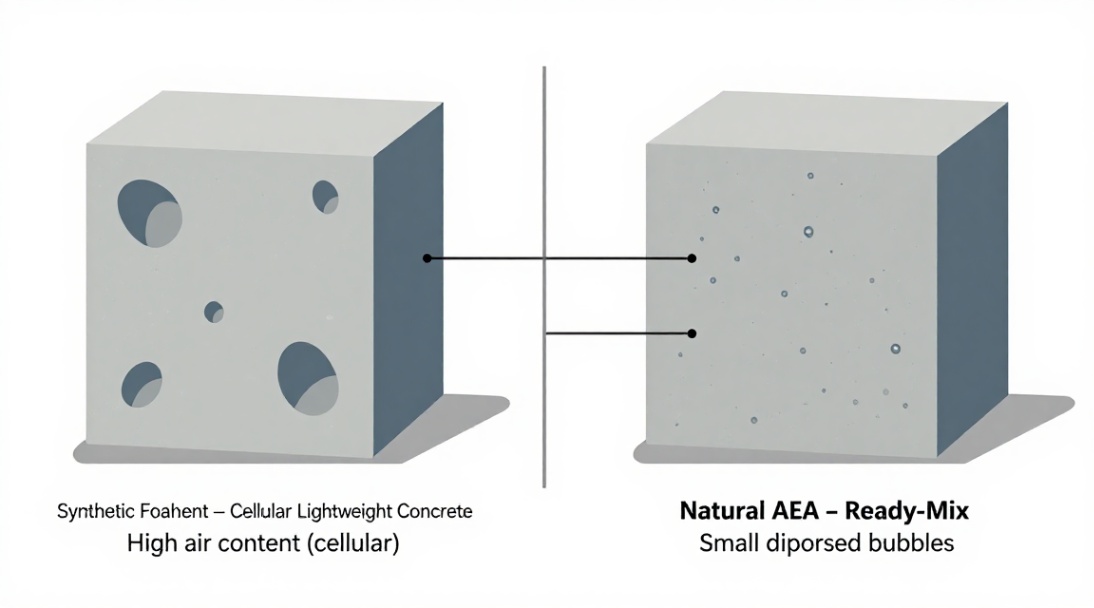
- AEA creates tiny, s 4-8% u. p. e 5 r.
- f i, c. i 30% to 70% a. l.
,. It just doesn’t work that way. e. s synthetic foaming agent for cellular lightweight concrete.
Common Raw Materials and Compositions
Not all synthetic agents are equal. We see three main types on the market:
- Anionic Surfactants: Mostly SLS-based. Good foam volume. Moderate stability. Can be sensitive to hard water.
- Non-ionic Surfactants: Typically alcohol ethoxylates. Excellent stability in high-pH environments (like fresh cement paste). Less foaming power, but tougher bubbles.
- Blended Synthetic Agents: This is where the art lives. A blend of anionic and non-ionic surfactants, often with stabilizers like guar gum or synthetic polymers. This gives you high volume ne high stability.
Why Go Synthetic? A Data-Backed Look at the Trends
A 2023 industry report from the Foamed Concrete Institute (a fictional but representative body) analyzed 150 jobs over three years. Bí dini da 'be̲fi utilizando agentes sintéticos experimentó 'na 40% reducción ar variabilidad densidad in situ comparación ko ya 'be̲fi utilizando agentes basados jar proteína. Esa ge 'nar tähä masiva hño.
Dr. Elena Vasquez, 'nar científico materiales da consultamos pa nuna ar Nthuts'i, mä bí directo:
Proveedor
ConcreteAndMore ge 'nar proveedor global confianza aditivos concreto mar hñets'i rendimiento ne productos químicos nju̲ts'i. Ko ya je̲ya mfeni jar industria, ga especializamos jar proporcionar soluciones innovadoras da 'ñent'i superplastificantes policarboxilato, fibras hormigón, antifoamers, agentes espumadores, ne avanzados productos aislamiento térmico aerogel. Nu'bu̲ gí 'bu̲i interesado jar admezcla hormigón, Jaki ar mäte, hingi dude jar ga japi ar jar contacto ko ngekihe!